Showing posts with label Green Roofs. Show all posts

Thursday, October 24, 2013

Green Roof Tour at Pittsburgh Zoo


On October 16, 2013, Jim Pashek joined old friends on a “Rooftop Rendezvous at the Zoo” sponsored by Green Building Alliance.  Jim was involved with project management of the “New Zoo” beginning in the early 1980’s and had the pleasure to work over the years with our tour guides that night, Frank Pizzi and Marjorie Marks.
Zoo Rooftop Garden - Extensive Plantings

What a spectacular demonstration rooftop garden.  About half of the planted roof area is an “extensive” roof garden with 3-4 inches of special soil mix.  The other half was this lush “intensive” rooftop garden of plants placed in a special soil mix ranging from 3-36 inches.  You can tell from the photos that they have been successful to identify species that can thrive in a very hot micro climate and in very shallow soils. 
Carex pennsylvanica
The garden got me thinking that the rooftop garden at Pashek Associates is ready for an overhaul.  This “extensive” garden is planted in trays on 4 inches of special soil mix.  We decided to try four varieties of sedums to see which would survive in very difficult site conditions.  They all survived and have never been watered since after the first growing season.

Some plants that we may plant include Carex pennsylvanica (the small grass clump like plants), which is one of the few sedges that tolerates very dry conditions.  I find it interesting that I would normally use Carex P. in part to full shade but at the Zoo, it is doing great in full sun.  I also think we will try in our rooftop garden Schizachryium scoparium, a plant that is home on the prairie and thrives in hot, dry, well drained conditions (the typical rooftop garden).

Schizachryium scoparium
Frank, thank you for a very informative presentation and tour of the Zoo’s rooftop garden gem.  Thanks also to the GBA for arranging the tour.  We look forward to another rooftop garden tour sponsored by GBA in November at the Convention Center, a green roof designed by Pashek Associates and installed by Eilser Nurseries.  Maybe next summer we will have more pictures of our newly renovated rooftop garden at Pashek Associates.  Please stop in and ask for a tour of our garden here on the Northside.

Wednesday, June 26, 2013

In Pittsburgh, Green is in the Air

It’s summer and that means the City is green with trees.  Not only are plants in the midst of their growing season, but people are in the midst of launching green initiatives.  Last week we attended a poster  session during the Who’s Who in Green Infrastructure Implementation event hosted by the Green Building Alliance and organized by 3 Rivers Wet Weather.  The event was packed with people interested in sharing their projects and learning more about green infrastructure. 

We brought along information on several of our green roof, green school, and green park projects.  At an elementary school in New Castle we were able to reduce the amount of stormwater piping and decrease the size of underground storage tanks through a combination of planted meadow areas, rain gardens, pervious overflow parking and fire lane, and a series of vegetated swales. 
For Whitehall Road Regional Park in Centre County, we are pulling out all the green stops by including rain gardens, steep slopes with meadows, vegetated buffer strips, infiltration trenches, and cisterns.  In addition, 44% of the total parking spaces are stabilized turf, which further reduces the amount of stormwater runoff. 
Our last poster featured our designs for the David Lawrence Convention Center green roof, the Allegheny County Office Building green roof, and the rain gardens at Seven Springs.
 
This morning over 80 people packed a Pittsburgh Zoo conference room to kick-off this year’s Green Workplace Challenge (GWC), a program of Sustainable Pittsburgh.  We took part last year in the challenge and are excited to enter again this year with the revamped program.  

This year’s GWC promises to be bigger, better, and have an even larger environmental impact than last year.  There are more points to acquire, more actions to take, and more resources available to help guide your business, non-profit, university, or municipality towards becoming more sustainable as well as saving money.  

Last year we saved 19.9% on our energy usage without spending a lot of money.  This year we want to reduce our energy usage even further by tightening up our building envelope.  We will also start to phase out our older lighting with new highly efficient lighting.  We highly recommend any organization in Southwestern Pennsylvania sign up for this friendly competition before the deadline on July 31st, 2013.  Good luck to all participants.  Together, we can make a huge impact!

Tuesday, April 2, 2013

County Building Green Roof Measures its Own Effectiveness


You may think of the Allegheny County Office Building, 452 Forbes Ave., Pittsburgh, as the place to go if you have a question about your property assessment.

But this historic building is also the site of a beautiful, functional and productive green roof, designed with the help of Pashek Associates. Green roofs benefit the local environment by reducing storm water runoff; keeping buildings warmer in winter and cooler in summer; evening out daily temperature swings; and helping to mitigate the heat island effect.

The County Office Building green roof, completed in 2010, is now growing into its role as a powerful tool for protecting the environment.

A network of sensors embedded in the soils monitor performance of this roof compared with a conventional “control” roof. The sensors measure roof temperature, soil moisture, water flow and water retention, with data collected every 15 minutes. Over time, this information will demonstrate the valuable role that green roofs can play in easing some of the damaging effects that development has on our environment.

Here is an example of the data that can be seen by visiting the monitoring website. This example compares temperatures in a one-month period on the control roof (top line) with temperatures recorded by two sensors on the green roof (bottom two lines).

The green roof includes four different types of growing conditions, and over time it will also be possible to learn through the monitoring system how each type performs compared with the others. They are:
  1. Intensive – 8 to 12 inches of soil and growing shrubs and plants needing the soil depth.
  2. Semi-intensive - 6 inches of soil and able to grow plants and shrubs.
  3. Roll out Mat – set on 4 inches of soil, this pre-grown sedum mat provides instant cover.
  4. Tray system – easy to install, pre-grown sedum and lightweight.

Friday, January 27, 2012

Pashek Associates Leading the Pittsburgh Green Workplace Challenge in Small Business Category


The Pittsburgh Green Workplace challenge enables businesses to participate in a friendly challenge program where they can receive recognition for their sustainable actions and achievements.  

Pashek Associates is leading 12 businesses in the small business category (less than 50 people).


According to Valerie Patrick, PhD and Sustainability Coordinator for Bayer Corporation, "sustainability is a way of thinking and applies to every aspect of our work."  We couldn't agree with her more.
Pashek Associates received points by tracking utility bills using an EPA website, being a bike friendly business, having a Prius for a corporate car, and planting native plants on the roof of their building.  Green office policies of using washable cups and recycling also contributed to the firm's leadership position in the challenge.  Next up is an energy audit to begin reducing energy demand and our carbon footprint. 
 
For more information, or if you are interested in signing up for the Challenge, please see the Pittsburgh Green Workplace Challenge Website.


Tuesday, September 27, 2011

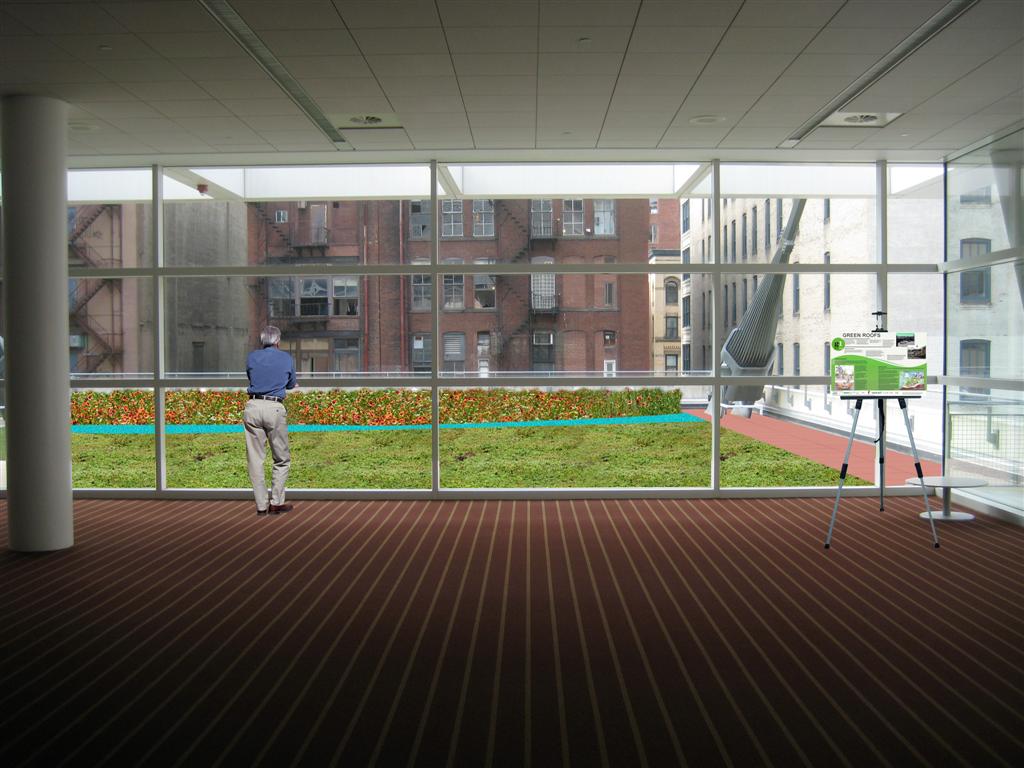
A Green Roof for a Green Convention Center

The Gold LEED Certified convention center in Pittsburgh is becoming even greener.  This fall, a green roof is being constructed above the loading dock and is fully accessible to event goers. 
In the summer of 2010, as planning and design was being completed for fixing a roof leak, the Sports and Exhibition Authority realized they had a golden opportunity to install and showcase a green roof that is readily accessible from meeting rooms on the third floor. 
Pashek Associates was hired to design the new roof to include outdoor gathering and event space along with planting areas.  The final design includes a meandering blue pathway resembling a stream, keeping with the theme of the existing architecture and meant to remind visitors of the green roof’s stormwater benefits.  The path separates two contrasting types of planting areas.  The first is a typical sedum planting done on most extensive green roofs.  The second consists of native perennials, providing wildlife habitat.  The simplicity of the design allows the building’s sculptural cable bundles to remain a focal point.
 Stay tuned for photos of the ongoing construction to be completed this fall!

Thursday, May 26, 2011

Permaculture, Community Revitalization, and Sustainable Design

A small, but growing, group of neighbors in East Liberty, called the Borland Garden Cooperative, have come together in order to develop a sustainable, multi-purpose urban garden that eliminates vacancy, adds vibrancy and biodiversity, and serves as an educational tool and community gathering space.   
Funded by the Community Design Center of Pittsburgh, Sprout Fund, and the Sarah Heinz Foundation, the Borland Garden Cooperative partnered with East Liberty Development Incorporated, Pittsburgh Permaculture, and GTECH Strategies to develop a unique urban garden model.  Pashek Associates was hired to develop a master plan for the garden in which energy and water will be captured, materials will be recycled and reused, and everyone who works in the garden shares tools and the harvest.
The group envisions the garden as a place in which the surrounding community can come together to learn, share resources, work together, grow together, and share in the bounty.  Some of the unique features of the garden include an urban food forest, traditional vegetable garden, water cistern, bio-shelter, rain gardens, chicken coop, outdoor kitchen and gathering space, and a labyrinth.   
Chimney swift habitat helps offer pest management as well as doubling as educational signage.  A windspire serves as a sculptural focal point as well as powering lighting.  Bee and butterfly habitat promotes pollination within the garden.  A sensory garden entices the public to walk up to, smell, touch, taste, see and interact with the garden.  Compost bins help recycle chicken manure, garden waste, as well as compostable materials from adjacent neighbors. 
The master planning process is almost finished but that does not mean the work is done.  The Cooperative will be out in full force to prepare for the installation of the rain gardens, cistern, street trees, and urban food forest in the fall. 

Monday, March 28, 2011

The Story of Our Green Roof: Part 2

Since we’ve constructed a green roof on part of our office building in late 2006, we have learned several things that we want to share:

Green Roof Type
Extensive
100, 2’x2’ trays with 4” of growing medium
Southern exposure

Plants
Sedum spurium 'Red Carpet'
Sedum album L
Sedum kamtschaticum var. ellacombeanum
Sedum rupestre

Lessons Learned
Irrigation – We watered periodically during the first growing season to get the plants established.  We did use a drip irrigation system during that period which made it a little easier.  Since then, we have removed the drip irrigation and haven’t watered anything, except once or twice when one of the staff has recognized that it hadn’t rained in several weeks.  We recommend sticking to a strict watering schedule in which the plants are watered thoroughly every few days for the first week or two, and then once a week for the first growing season.  Long, deep watering encourages deeper rooting and stronger, healthier plants.  If the water just reaches the surface, so will the roots, which prevents the plants from gathering more water during droughts.
Maintenance – During the first and second growing seasons, we weeded the green roof several times a year.  Since then, we have weeded once or twice a growing season.  Typically, an employee will take a break from their daily grind to spend five or ten minutes on a beautiful day weeding.  

Plant Selection – All of the sedum have been doing well except Sedum spurium ‘Red Carpet’ which seems to get scale.  We recommend mixing a large variety of species in order get a higher survival rate and ensure that a disease won’t wipe out an entire area.  Sedums work well with shallow soils such as on our roof.  However, most are non-native.  If you want more native plants, six inches or more of growing medium is best. 

Environmental Benefits – Our green roof retains up to 95 gallons of water during a rain storm.  That’s up to 95 gallons of rain water that doesn’t flow directly into the Combined Sewer system and into the Rivers.  It is also providing some refuge for several species of bugs.  We haven’t measured the air quality, but know that our green roof is producing more oxygen and absorbing air pollutants. 

Cost Benefits – We are in the process of figuring out how much energy we save due to the green roof.  We already know that it is protecting the rubber membrane underneath from harmful UV rays and therefore extending its normal life span. 
Final Thoughts – If you are part of a small office building with just a few employees, constructing a green roof is possible with just a little bit of effort and money.  Sedums are the easiest to maintain.  Creating a maintenance schedule for the first two growing seasons will help ensure that your investment does not die.  Our office has a dishwasher and trash duty schedule in which each employee is responsible for about one month out of the year.  This can be adapted to a green roof maintenance schedule.  If you really want to know all of the specific benefits your green roof will have, try installing monitoring equipment or just look at your utility bills.  Finally, we couldn’t tell everyone that they should put green roofs on their buildings unless we also encourage them to first consult a structural engineer to determine if a green roof is feasible.

Monday, March 21, 2011

What is Green Infrastructure?

When you think of infrastructure, you usually think of things like roads, sewer systems, water supply, power grids, etc…  It is the basic physical structures needed for a community to enable, sustain, or enhance a certain standard of living for its residents.   It enables the buying and selling of goods and services at a more efficient level.  Could you imagine your workplace without internet, electricity, or even roads connecting you to your clients? 
Wetlands and riparian buffers are green infrastructure.
 But what does it mean when “green” is placed in front of the word infrastructure?  Green Infrastructure is a concept that can, and should, be applied to all different scales of planning and design.  Basically, it includes everything from strategically planned and managed networks of natural lands, to working landscapes, to recreational landscapes, and other open spaces that conserve ecosystem values and functions.  In other words, greenways, parks, riparian buffers, wetlands, floodplains, rivers, and even stormwater Best Management Practices such as rain gardens, porous pavements, green roofs, and trees are all part of Green Infrastructure.  It recognizes the importance of natural systems and processes within our communities.
Green roofs and rain gardens are green infrastructure.
Why has Green Infrastructure become so important in the last 10 or 20 years?  Well, because it is beneficial for the environment, human health, the economy, and our society as a whole.  Working with and using natural processes ensures that we’ll have resources for future generations.  Stormwater BMPs reduce flooding, pollution, and the strain on our storm sewers.  Street trees beautify our neighborhoods, increase property values, reduce the urban heat island, and absorb air pollution and stormwater.  Greenways help protect steep hillsides from being developed and eroded, protect wildlife habitat, and offer recreational opportunities.  Constructed wetlands not only provide wildlife habitat but filter pollution and even human waste. 

So the next time you step outside, try to identify what types of green infrastructure are present and how they help to make your community a better place.

Monday, March 7, 2011

The Story of Our Green Roof: Part 1


In 2006, Pashek Associates decided to experiment with designing and building a green roof on our 1890’s office building located at 619 East Ohio Street on the Northside.  We wanted to see what we could do with a little money, a little time, and a little physical labor.  After discussing different options, we decided on a simple extensive tray system, mostly because the manufacturer was using them on a larger project in the city and agreed to put an extra one hundred trays on the truck and deliver them at a discounted price. 
One cold December morning, we put on our working gloves and carried the 50-pound trays filled with special growing medium into place, assembly line style.  Each 2’x2’ aluminum tray was set down on five small rubber pads to allow excess roof runoff to flow under the trays and into the existing roof drain.   No other material was applied directly to the roof.  It was as simple as that!
 Then, on a warm spring day, the whole office pulled our gloves back on and planted the trays with several varieties of sedum.  We used small plugs and get them a good soak using water from a rain barrel attached to our third floor roof.  We did install a drip irrigation system for the first growing season.  We have removed the system and haven’t needed to water the plants since.
 A couple years later, we thought we had a roof leak.  A roofing contractor moved the trays around the roof in order to find the leak.  He was surprised to find that there was almost no degradation of the roof membrane as a result of the green roof trays.  Ultimately, instead of finding a leak in the roof, the contractor found a leak in a brick wall.  That's when we knew that our green roof was really doing it's job!